
Is Wood Veneer Durable? Why Veneer Is More Stable Than Solid Wood
Is Wood Veneer Durable? Why Veneer Is More Stable Than Solid Wood
Someone called me some time back asking about their bedroom wardrobe. The carpenter had suggested veneer, but their neighbour told her it peels in two years and should just go for solid wood. They were confused, and honestly I understand, I have heard the same thing from many people.
So let me clear this up. Is veneer durable? Mostly yes. Is it more stable than solid wood? Also yes, and in Mumbai it matters even more but there are some conditions, and we will discuss it in detail below.
First, what is veneer?
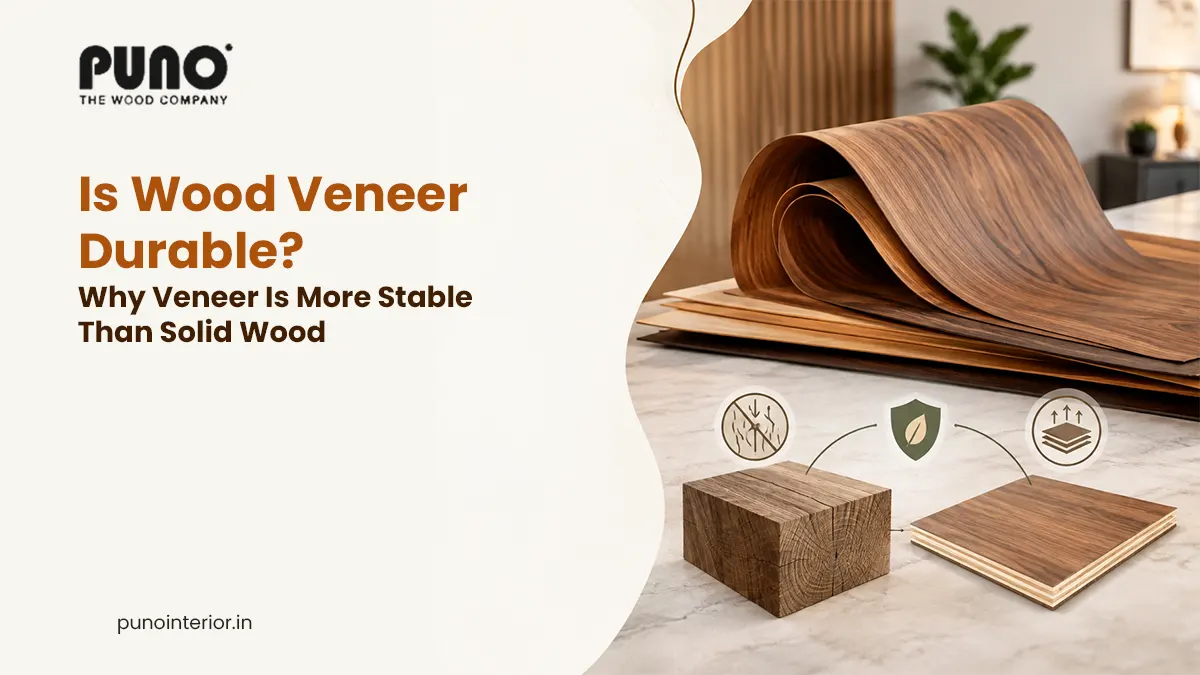
Veneer is real wood. Just very thin. Think of a sheet around 0.5 mm to 3 mm thick, cut from a log by slicing or peeling. This sheet is then pasted on a board, usually plywood or MDF, under a press.
A lot of people think it is a printed sheet but it is not, that is laminate. With veneer the grain is natural, and every sheet is a little different from the next. When you run your hand on it, you feel wood.
One more thing nobody talks about. A single log gives you hundreds of sheets, so you cover a big area with very little wood. For the same area, solid wood needs thick planks and that means more trees cut, so veneer is also a bit kinder to nature.
How long does it last?
If it is made properly, 15 to 20 years is normal, many go longer. Many old wardrobes in Mumbai flats, maybe 20 years old, with veneer still holding. The colour got a bit darker, that's all.
Now the problem is some veneer work is really bad- thin sheet, cheap glue, rushed pressing, weak board. Such work will bubble up or peel, especially after one or two monsoons and then the owner says veneer is useless but the veneer was not the problem but the shortcut was.
So what decides life? Mainly the quality of the sheet, the board below it, and how well the carpenter or factory has done the pasting. Weak in any one place and the whole thing goes down.
Almost all veneer also gets a coat on top, like PU or melamine. This coat is like a shield, it keeps off small water spills, dust and light scratches, it also makes cleaning easy.
Why is it more stable than solid wood?
This is the real reason people should choose veneer, so we will go slowly.
Wood takes in moisture when the air is damp, it swells. When the air gets dry, it gives the moisture back and shrinks, this keeps happening all year. Solid wood is full wood, so the movement is big. In Mumbai the monsoon is very wet and the rest of the year is much drier, so solid wood goes through a lot.
You must have seen it. The door that closes fine in March but sticks in July, the dining table with a thin crack down the middle. The drawer that was smooth last year and now needs a hard pull, sometimes a long shelf even bends a little in the centre.
Veneers on a good plywood board behave differently. Plywood is made of thin layers stuck together, and each layer runs in the opposite direction to the one below it. So if one layer tries to swell, the other holds it back. They cancel each other, more or less, the board stays flat and since the thin veneer is stuck firmly on top, it just follows the board.
That's it, no magic. Just how the layers are built, for a big sliding wardrobe or a wide wall panel, this matters a lot, because even a small bend in a large surface is easy to notice.
Solid wood is not bad
A heavy teak bed or a dining table can stay in a family for generations. If it gets scratched, a carpenter can sand and polish it again. Do that on veneer too many times and you will go through the thin layer.
But solid wood costs a lot, it is heavy to lift and fix. It moves with the weather, as said earlier and good wide planks without knots are getting hard to find, prices go up almost every year.
Veneer is lighter and cheaper. You can get a walnut or oak look without paying that kind of price. Also the pattern can be matched nicely across a big door, so the whole wardrobe looks like one piece. With solid wood, one plank may be dark, the next one light, and you just accept it.
My own view? For big work like wardrobes, kitchen shutters, TV units and wall panels, veneer makes more sense. For one special piece that you want to keep for life, go solid, many homes use both, nothing wrong in that.
Where veneer goes wrong
Water is the first enemy. If water stays on it for days, near a leaking pipe or in a damp corner, the glue loosens and the sheet lifts. Don't use normal boards in such places, instead use a water-resistant board and seal it well.
Then there is bad pressing, some units are in a hurry and don't press enough, or they use cheap glue. You get small air pockets and after a few months the edges start coming off, this is the most common complaint.
And edges, people forget edges. If the sides are open, moisture enters from there and the damage starts quietly from inside. By the time you see it, it is already late, so look at the edges and corners when the work is delivered.
All these are avoidable. Most trouble comes from low price and low quality, not from veneer as a material.
Taking care of it
Not much to do really- wipe with a soft cloth, a little damp is okay, don't pour water or use strong cleaners, put a mat under hot vessels and a coaster under wet glasses and don't drag heavy stuff across it.
In monsoon, open the windows when you can and let the house breathe, a closed damp wardrobe is not good for anything. Some people keep silica packets or camphor inside, it helps a little.
If a corner starts lifting, fix it fast. A small repair costs very little, wait six months and it becomes a big job.
How to choose veneer
Don't just look at colour, touch the sheet. Is it smooth? Is the grain even or patchy? Ask what board is used under it, what glue, and how thick the veneer is. If the seller gets annoyed with these questions, that tells you something.
Try to buy directly from someone who actually makes it or supplies it, not from a long chain of middlemen. A proper Veneer Manufacturer in Mumbai can control the quality and give you a better rate, and you know whom to call if something goes wrong. A good Veneer Supplier in Mumbai usually keeps many types in stock, so you can see them side by side.
Take a sample home, keep it in your own room light for a day or two. Veneer in the shop's bright lights looks very different from veneer at home, many people learn this the hard way.
Final thoughts
Veneer is durable when it is made well and it is more stable than solid wood because of the layered board underneath, which doesn't swell and shrink like a full plank. In a humid city like Mumbai, that is a real advantage, not just a sales line.
Solid wood has its place but for most house work, veneer gives you the real wood look, a steady finish, and a price that doesn't hurt, just pick the right material and the right people.
Planning veneer work? Talk to Puno Interiors
If you are doing a wardrobe, wall panel or any furniture, please don't risk it with weak material. Talk to Puno Interiors, we are a Veneer Manufacturer in Mumbai and Veneer Supplier in Mumbai that cares about even sheets, strong pressing and finish that lasts.
We have many designs and finishes. Come, see them, touch them, and pick what suits your home.
Why keep searching for a Veneer Manufacturer when Puno Interiors is here? Call us, ask for samples, and get a clear price. For a Veneer Supplier** **you can trust, remember Puno Interiors.
Contact today, your Veneer Manufacturer in Mumbai for the next project.
